 Further reports:
Summer 2023
Winter 2023 to Winter 2024
Summer 2023
Winter 2022/23: Working on the turret
Winter 2021/22 and summer 2022: Working on the turret
Winter 2020/21 and summer 2021: The electrical system and hull
Winter 2019/20 and summer 2020: Turret and the electrical system
Summer 2025
The major projects of summer season 2025 revolved around completion of the platform for the turret crew and the beginning of the revision of the steering gear.
Already in the previous report I addressed the very bad accuracy of fit and necessary reworking of parts for the turret platform. E.g. we had to weld thick spacers to the traverse in order to make the radii of the outer edges of the adjacent segments on each side fit. The clearance was later covered with metal sheets.

The large rectangular opening in the front left segment holds the swivel pedal for the gunner to determine direction and speed of rotation of the turret. The unit existed on our Tiger, however, some parts were missing. We were able to reproduce them from originals which we borrowed from a different museum.
Visible on the photos are:
The gunner’s seat with the hand wheel for fine adjustment of the gun and the lever on the lower left side of the seat which, like the pedal, adjusts speed and direction of the turret rotation.
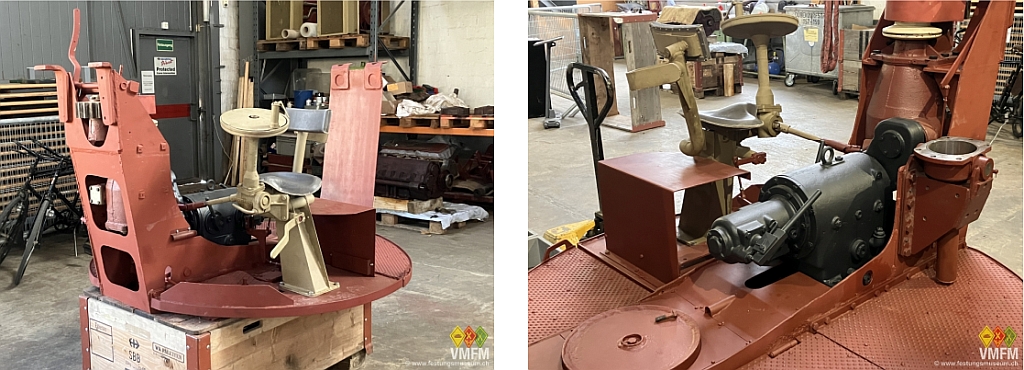
The cover behind the seat which is supposed to house a compressor to provide compressed air to blow gases out of the barrel after firing. The compressor was missing in our tank. The cylindrical container in the rear of the traverse holds the compressed air.
The power traverse hydraulic drive, in grey, features a hand lever at the rear right. This lever operates a lamella clutch system in order to establish or separate the friction from the engine to the drive. Not yet installed is a pulley for a belt which drives the compressor.
On the right side in front installed is the lower part of the elevation gear for the main gun. The unit was missing entirely on our tank. We received some parts as reproductions but the inner toothed wheels were missing. Fortunately, we discovered that the elevation gear of the Jagdpanther which we have in our collection has the same basic setup. Björn is in the process of having the parts in question reproduced. Eventually we plan to have two complete units.
Transmission and steering gear of Tigers are one unit. They can be revised separately but can be tested only as one unit. The reason is that both have shared oil circle and the central oil pump installed in the transmission.
Initially, the specialized company which has revised the transmission planned to revise the steering gear as well. However, due to individual restrictions on our and their side we agreed that the gear be returned to us. After some major discussions we decided to try the revision by ourselves.
The steering gear is a double-Radius gear. It doesn’t work like a continuously variable steering like in cars but has two fixed radii. Along with the number of gears in the transmission, in the King Tiger 8 gears, a total of 2 x 8 = 16 theoretical gears is available.
Unlike for the transmission, there are only very few technical documents of the steering gear, and so a lot of people in our museum have thought a lot about how to approach that project. Despite of its relevance for operating the Tiger, for fear of damaging something unintentionally, a common opinion developed to do as little work on the gear as possible. One otherwise rational guy with huge experience in restoring Panthers even suggested to install it again as it is. Fortunately, eventually the rational asserted, and now the gear is in the process of being disassembled step by step, considering the possible consequences of each step.
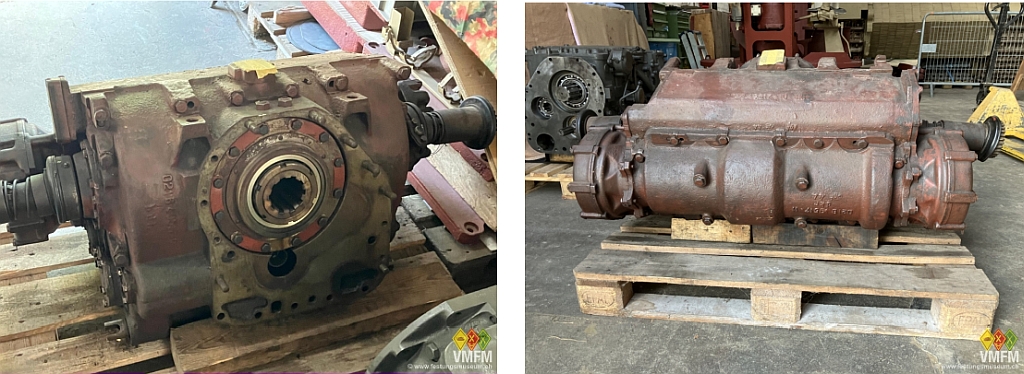
The front side towards the transmission has two entrances for the large drive shaft and a second smaller shaft. Further, around the outside edge, some centering pins, the bores for the bolts and a couple of openings for the oil circle. Transmission and steering gear are connected without a gasket.
The detachment of the massive drive wheel and the two driveshafts were an easy start. The drive wheel of the King Tiger is located inside the housing of the steering gear, unlike Tiger I where it is mounted outside of the gear box.
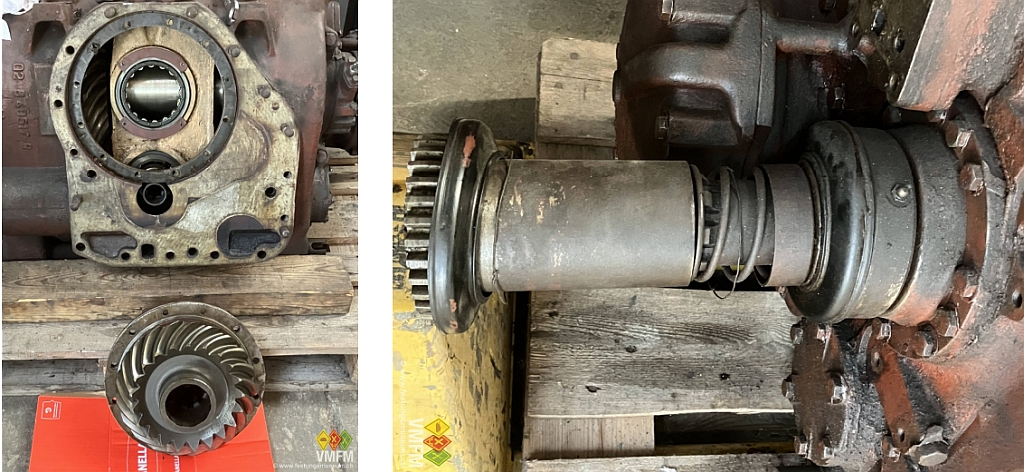
The two driveshafts are kept in the final drives by spring pressure and friction is achieved by a special toothing.
Removal of the lid on the rear side viewed from the entrance of the large drive shaft revealed the following:
